|
Alaska Blind Child Discovery
|
A
cooperative, charitable research project to vision screen every preschool
Alaskan |
| |
Early Objective Screening
|
|
| |
|
Photoscreening
and remote autorefraction can be successfully
performed on very young children. this inlcudes nursery aged (2-4 years)
when acuity testing can be done only by
expert screeners with cooperative children, toddlers (aged 12-24 months)
who cannot yet perform patching acuity, and infants aged birth to 12 months.
To determine if early objective screening is better than waiting until children
are older than 4 years and able to practically perform acuity testing, it
takes large-scale studies with long-term follow-up. |
|
| |
|
|
| |
|
|
| |
|
|
| |
|
|
| |
|
|
|
|
|
|
| |
|
Janette
Atkinson, et al videorefracted infants aged 8-9 months to detect high
hyperopia. Those randomized to spectacle treatment had better acuities and
stereopsis than age / community matched children when they reached age 6
years. |
|
| |
|
|
| |
|
|
|
|
|
|
|
|
Sean
Donahue reviewed anisometropic children detected from community MTI
photoscreens of over 119,000 children in Tennessee. For each year younger
screened, the proportion and severity of amblyopia decreased. In his AAPOS
talk, Donahue noted that the profound age-dependence was greatest for increasing
anisometropia over 1 diopters.
Teed RG, Bui CM, Morrison DG, et al. Amblyopia therapy in children identified by photoscreening. Ophthalmology;117(1):159-62.2010. |
|
|
|
|
|
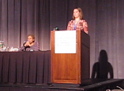 ABCD
Results Video presented at AAPOS
by Valerie Kirk ABCD
Results Video presented at AAPOS
by Valerie Kirk |
|
|
|
|
|
|
|
|
Valerie
Kirk and Michelle Clausen reported
the ABCD experience fromthe 6% positive referrals with 82% PPV from over
21,000 lay screenings under age 4 years who were followed at least two years
and after age 6. Infants and toddlers (n=36) had better average acuity (0.17
logMAR) patched HOTV than did those screened at nursery-age (n=54, 0.26
logMAR) (Archives of Ophthalmology 2008) |
|
|
|
|
|
|
Stiff H, Dimenstein N, Larson SA. Vision screening outcomes in children less than 3 years of age compared with children 3 years and older. J AAPOS. 2020;24(5):293 |
|
|
ABCD
concludes that early objective screening with consistent spectacle
therapy can result in better amblyopia outcomes and therefore should be
actively supported and Funded wherever technology
is available. |
|
|
|
|
|
|
|
|
|
|
 |
|
|
|
|
|
|
 |
|
|
|
|
|
|